In a closed domain the two must coincide at every instant; the gating check is the final value.
P1
P2
P3
P4
P5
P6
P7
Gaps are times when the cell at that point is dry.
What happens
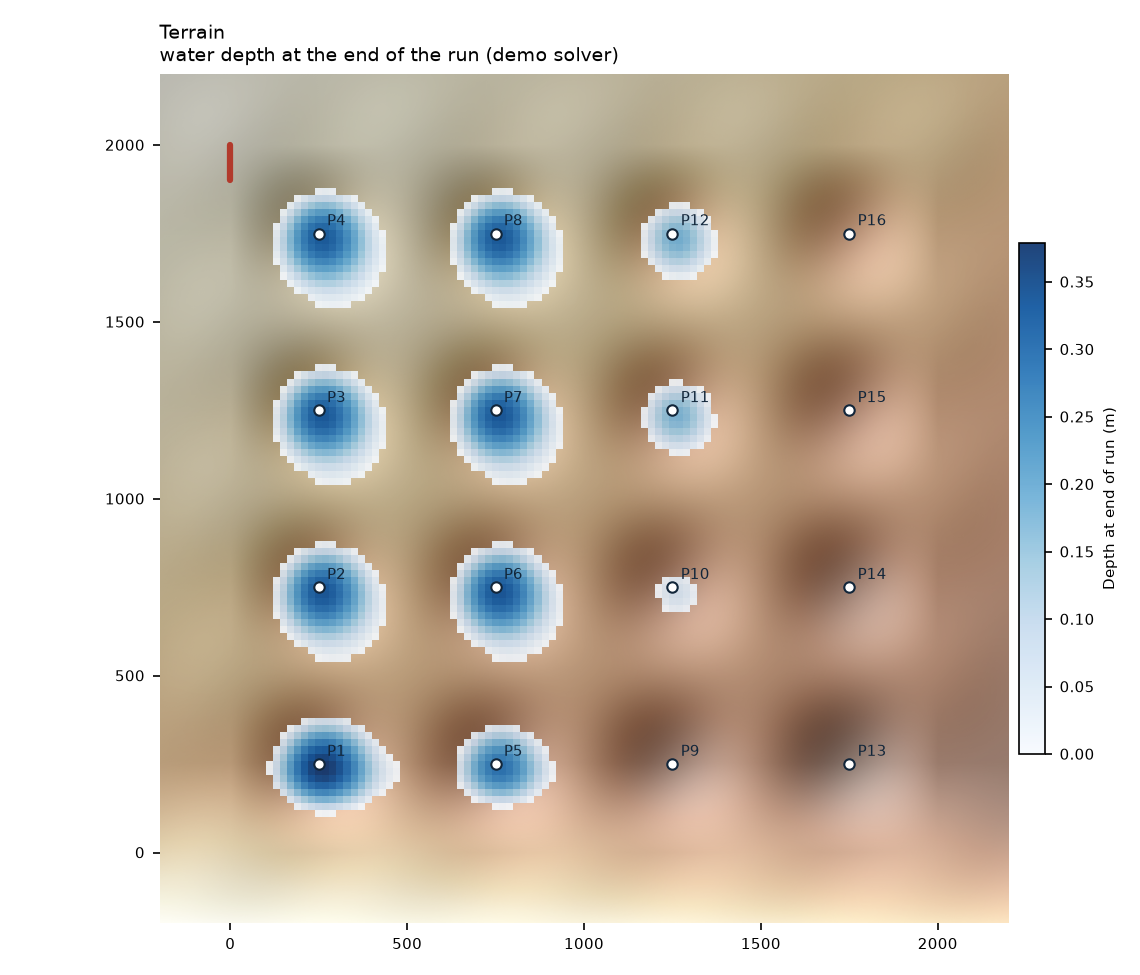
A short flood spreads over a floodplain dotted with 16 shallow hollows and slowly fills them.
Why it matters
Slow, shallow filling is where models with poor wetting and drying lose water.
A good model must
store exactly the water let in (within 0.1 %)
Exact answer and models
Water level at gauge P1 (250 m, 250 m)
There is no exact water level here; the test is scored on stored volume. Levels are shown so the models can be compared with each other.
Point at the chart to read every model's value; click a name to hide or show it.
Water level at gauge P8 (750 m, 1750 m)
There is no exact water level here; the test is scored on stored volume. Levels are shown so the models can be compared with each other.
Point at the chart to read every model's value; click a name to hide or show it.
How models did
In rank order: by each model's percent difference from the right answer, the largest over the test's accuracy checks (lower is better; results within 10 % of each other share a rank). Mass error, timing and NSE are shown beside it, not folded in. Each model runs the same inputs. Compare them in the results viewer (depth maps and animation) →
The model files for this run will be published with its next run.
ANUGA builds its mesh and boundaries in Python: the script is the model.
The test itself (inputs, exact answer, checks): A2C-EA2.zip. Check the score card with benchmark1d2d verify-card: its signature by the suite's public development key shows the card has not changed since it was written, not who wrote it.
The test itself (inputs, exact answer, checks): A2C-EA2.zip. Check the score card with benchmark1d2d verify-card: its signature by the suite's public development key shows the card has not changed since it was written, not who wrote it.
LISFLOOD-FP ACC
LISFLOOD-FP 8.3, the local-inertia solver it is best known for; it leaves out the advection term
#1= under 0.01 % off
Run time, finest grid: 32.2 s· AMD EPYC 7763 64-Core Processor, 2 cores, 15.6 GB, Linux 6.17.0-1022-azure (GitHub Actions (github-hosted, ubuntu24))
The test itself (inputs, exact answer, checks): A2C-EA2.zip. Check the score card with benchmark1d2d verify-card: its signature by the suite's public development key shows the card has not changed since it was written, not who wrote it.
The test itself (inputs, exact answer, checks): A2C-EA2.zip. Check the score card with benchmark1d2d verify-card: its signature by the suite's public development key shows the card has not changed since it was written, not who wrote it.
Demo 2D
Worked example that ships with the suite: first-order finite volume
#1= under 0.01 % off
Run time, finest grid: 47.1 s· AMD EPYC 9V74 80-Core Processor, 2 cores, 15.6 GB, Linux 6.17.0-1022-azure (GitHub Actions (github-hosted, ubuntu24))
The model files for this run will be published with its next run.
The test itself (inputs, exact answer, checks): A2C-EA2.zip. Check the score card with benchmark1d2d verify-card: its signature by the suite's public development key shows the card has not changed since it was written, not who wrote it.
TELEMAC-2D
openTELEMAC-2D 9.1.1, run with its default finite-volume settings
#1= under 0.01 % off
Settings: telemac2d (Selafin, nodes at the grid's cell centres)
Water conserved
• 0.0086 % off
Run with a 1 s largest step, as for the other codes: with TELEMAC's step left to the 5-minute output interval, the dry start took long first steps that undersampled the inflow and lost 6 % of the water.
The test itself (inputs, exact answer, checks): A2C-EA2.zip. Check the score card with benchmark1d2d verify-card: its signature by the suite's public development key shows the card has not changed since it was written, not who wrote it.
HEC-RAS 6.6
HEC-RAS 6.6 2D with its Eulerian shallow-water option (SWE-EM), the release before 7.0
#7= 0.72 % off
Run time, finest grid: 3.8 min· AMD EPYC 7763 64-Core Processor, 2 cores, 16 GB, Windows 2025Server (GitHub Actions (github-hosted, win25-vs2026))
The test itself (inputs, exact answer, checks): A2C-EA2.zip. Check the score card with benchmark1d2d verify-card: its signature by the suite's public development key shows the card has not changed since it was written, not who wrote it.
HEC-RAS 7.0
HEC-RAS 7.0.1 2D with its Eulerian shallow-water option (SWE-EM), which HEC recommends for dam breaks
#7= 0.73 % off
Run time, finest grid: 4.0 min· AMD EPYC 7763 64-Core Processor, 2 cores, 16 GB, Windows 2025Server (GitHub Actions (github-hosted, win25-vs2026))
The test itself (inputs, exact answer, checks): A2C-EA2.zip. Check the score card with benchmark1d2d verify-card: its signature by the suite's public development key shows the card has not changed since it was written, not who wrote it.
HEC-RAS 6.6
HEC-RAS 6.6, the release before 7.0, run the same way (1D, and 2D with its default SWE-ELM): kept so a change between versions shows
#7= 0.77 % off
Run time, finest grid: 3.9 min· AMD EPYC 7763 64-Core Processor, 2 cores, 16 GB, Windows 2025Server (GitHub Actions (github-hosted, win25-vs2026))
HEC-RAS's own volume accounting reports 1.4 % more water stored than flowed in (98,576 m³ from 97,194 m³). Integrating its water levels over the 2 m DEM gives +0.76 %. Run on the EA's own 2 m DEM as sub-grid terrain.
The test itself (inputs, exact answer, checks): A2C-EA2.zip. Check the score card with benchmark1d2d verify-card: its signature by the suite's public development key shows the card has not changed since it was written, not who wrote it.
HEC-RAS 7.0
HEC-RAS 7.0.1 (US Army Corps of Engineers), built and run headless with its default settings; in 2D, its default full shallow-water option (SWE-ELM)
#7= 0.79 % off
Run time, finest grid: 3.3 min· AMD EPYC 9V74 80-Core Processor, 2 cores, 16 GB, Windows 2025Server (GitHub Actions (github-hosted, win25-vs2026))
The test itself (inputs, exact answer, checks): A2C-EA2.zip. Check the score card with benchmark1d2d verify-card: its signature by the suite's public development key shows the card has not changed since it was written, not who wrote it.
Not run yet: GeoClaw, TUFLOW, MIKE 21, Iber, BASEMENT, Delft3D FM
Technical details for reviewers Checks, reference, inputs, sources
Checks and why each limit was chosen
Check
Difference measured as a percentage of
Latest
Difference
Why this check
mass_conservation
expected_state_error of volume · in the score
already a percentage
–
The only exact statement the test admits: nothing leaves a closed domain, so any difference is mass created or lost by the scheme (suite target < 0.1 %).
Reference
No exact or measured answer exists. The test is scored on states that follow from the inputs alone; published package results are context only.
Expected state
Value
Why it must hold
final_stored_volume
volume
97,200 m3
Closed boundaries and a dry initial bed: stored volume at the end of the run equals the linearly interpolated inflow hydrograph integrated to t_end.
More figures
Cumulative inflow (exact)
Stored volume, demo solver
In a closed domain the two must coincide at every instant; the gating check is the final value.
P1
P2
P3
P4
P5
P6
P7
Gaps are times when the cell at that point is dry.
Promotion checklist
Only frozen tests have fixed inputs and answers. This list is computed from the manifest and the published score cards; the rules are in the method.
✓Data licence verifiedfor candidateOGL-UK-3.0
✓All inputs availablefor candidateall committed or fetched by SHA-256
✓Reference (truth) availablefor candidateobjective expected states
✓Every tolerance justifiedfor candidateeach gating criterion has a rationale
✓A published run passesfor frozen6 passing score card(s)
✓Order of accuracy shownfor frozennot a verification case
Probe levels and velocities are compared with the published package spread for context only.
Data and licence
Inputs come from the GOV.UK 'Benchmarking model data' archive, published under the Open Government Licence v3.0 (the page licence; the archive carries no other terms). Attribution: Environment Agency, SC120002 (2013), test specifications May 2010.